Archive for the ‘Tools and techniques’ Category

Dye kit (and a day’s adventures)

Sunday, May 16th, 2010

This weekend i pulled out my kit to see what was needed (trays for tray dying) and what i had misplaced. I don’t think i’ve technically misplaced my respirator, but it’s not in the dye kit. I expect it’s in the closet.

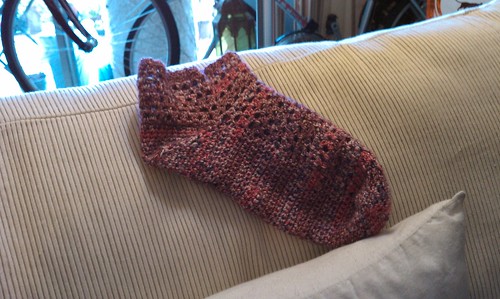
Over the past few weeks i’ve tied my shiburi/tie-die patterns in the rayon dresses and have been winding up skeins of crochet yarn on my experimental swift.

I hesitated this weekend to mix the dyes: it’s a very demanding week coming up and i don’t quite think i can be sure i can dye next Saturday as well. I need to make some decisions about dye intensities, quantities, and recipes, and i think i’m about ready to go.


IMG_0560Nightgown Tie patternNightgown Tie pattern
Old jeans dyebath layoutNightgown Tie pattern die lay-outNightgown Tie pattern die lay-out
Ad Hoc Yarn SwiftAd Hoc Yarn SwiftAd Hoc Yarn Swift

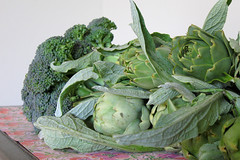
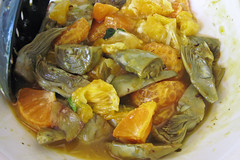
I did get a pleasant bit of cooking in. I’m glad i hadn’t yet cooked the baby artichokes i received in my organic box on Wednesday, because it wasn’t until yesterday morning that this recipe for a artichoke and orange salad with mint and saffron showed up in my reading list. I didn’t want to wait until i had slivered almonds and the right olives, so i made it anyway. I was in the mood for a warm dish, and couldn’t bear the thought of just draining off the saffron infused water the artichokes had been cooked in, so i added a bit of corn starch to thicken it and poured the warm dish over rice. Delicious.

IMG_0509Artichokes with Saffron and Oranges

After the cut, the dye kit inventory.
(more…)

Experimental Swift and Rake

Wednesday, December 9th, 2009

While i have convinced myself that the half ounce of alpaca (tightly wound into a classic cat toy ball) is all i need to make my current project, the question of swifts and ball winders has stayed with me.

On Sunday i stopped at the hardware store to pick up Escutcheon pins ($1.79 for 1.5 oz). These were sharp enough to insert into a bit of balsa wood by hand at quarter inch intervals. I experimented with an e-wrap cast-on using #10 crochet thread. I now have an experiential understanding of the warnings about tension: getting the tension loose enough that one can move all the loops is a challenge when using thread. I’ll try some light yarn next. (If any alpaca is left over, that might be suitably springy, too.)

While at the hardware store, the issue of the swift and my more concrete need for an efficient way to create skeins for dyeing was in mind. It turns out that one can buy the ball bearing case for a lazy susan. I have the Shepherd Hardware Products Lazy Susan [product 9547 4" diameter, 100 mm ball bearings, 300 lb load, $4.49].

To make a swift (which turns as one pulls the yarn off) i just need four of the 6-32×2″ machine screws (I’d have called it a bolt), but a fifth for the center will allow me to install a crank (rigged out of a sixth bolt). (15 bolts: $2.04; 3 sets of six nits at $0.54 each.) The cross bars for the first draft of the swift are yardsticks ($0.99 each). The wood is soft enough that i was able to make the bolt holes with an awl. This is a sign that the yardsticks may not be durable. However, it remains to be seen if they are good enough for casual work.

My plan is to make four “C” shaped hooks from two wire hangers, and then use binder clips to hold those to the yardsticks. Figuring out the circumference of skeins should be a pleasant bit of geometry.

This leaves the challenge of *mounting* the lazy susan base. At the moment, it’s duct taped on two corners to a microphone stand. This is probably less durable than the yardsticks. I want to see if a standard broom handle fits in the mike holder: if so, wood screws into the mike holder and the mike holder on the stand might be satisfactory (although the mike holders were probably not designed to hold something undergoing torque.

While in the hardware store i bought two 2″ spring clamps ($2.99). I imagined extending the lazy susan base and clamping that to a table or chair back, but once home the thought of duct taping the thing to a five gallon cubic water bottle came to mind: for safety’s sake we should have water bottles around at all times, and the temporary solution is all i need. I suspect that people with wall space and workshops could mount the thing onto walls or tables for a permanent solution. Christine just happens to have two mike stands on which i stub my toe occasionally. The audio recording job she got them for never repeated, so she’ll let me use one. (Who knows, that might just be enough for someone to enquire after her recording skills again.)

I’m just left with the challenge of making a crank. The balsa i have was too fragile and did not survive the awl-piercing. A third hanger might provide another rigged solution. The next step, when i next have time, is to experiment with a mike-stand mount.

2000 yards of lace weight alpaca: advice welcomed

Sunday, December 6th, 2009

I have over two thousand yards (8 oz) of laceweight alpaca in a large skein. It seemed like a good idea at the time.

Also, oh my heavens, it is softer than an angel’s kiss. I just hugged it for a while until i started panicking about how tangled it was going to get.

I spent some time (over thirty minutes on the phone, plus) winding it into a 0.5 oz ball — and then discovered my tight wind was bad for the yarn. That bit of yarn is probably OK for the time being — that’s all i’ll need, i suspect, to make alpaca angels. But what about the rest? Apparently $100 is the average price for a swift and a ball winder. Maybe i want the swift? Would that do the same thing my careful winding around my sewing board does to make skeins for dyeing? Ah, apparently i should have a niddy noddy for that. I almost think i could construct my own niddy noddy.

$40 + $25 for wooden swift and plastic winder
http://www.stanwoodimports.com/servlet/Detail?no=58
http://www.stanwoodimports.com/servlet/Detail?no=43

This is apparently a Good Deal. Suddenly the 2000 yards of alpaca got more expensive. On the other hand, dying yarn takes skeins, and skein management is time consuming.

Also, the tiny angel ornament i began crocheting lets me know that this is not as easy to crochet as crochet thread.

I am fantasizing about making a crochet and loom knit kimono-like jacket out of it. (See this design, but not a long kimono as diagrammed but hip length.) Not much shaping. I suspect i’ll be using this yarn in about ten years when my skill begins to reach the yarn.

Oh, and if i did that, the yarn could be dyed in multiple colors: first creating a long strip, weighing it, calculating numbers of strips to make the kimono panels…. (more…)

Yuletide Experiment, to dye for

Saturday, December 5th, 2009

We’re planning on giving Heifer International’s gift of a llama to our family this year. I’d like to make something, too, and had been thinking about finally getting back to my dying projects and making up some shibori handkerchiefs for friends and family. Dharma Trading Company also has alpaca yarn: #YARN24 Alpaca Lace: 100% superfine alpaca, ~8 oz., 2,480 yds

I haven’t used my fire red dye yet. Hmmm. On the other hand, this angel pattern [Ravelry] is perfect for white yarn. But then there will be over a thousand yards left, surely.

Iowa weaver’s notes about dying wool with procion dyes got my attention. She links to this PDF instruction sheet, skipping the same mysterious special wool ingredient, using vinegar as i would. Dharma’s method is altogether different.

I also think i could stand to experiment with the silk ribbon and the mohops. Perhaps it will be a mistake, but i’m going to give the bias cut ribbon a try first. (Will it pull apart under the tension?)

Links to shibori sites after the cut. (more…)

Why Golden Paints rock my boat

Friday, September 18th, 2009

The latest issue of Golden Paint’s “Just Paint [PDF]” is out. I was going to skim, but the cover article “The Subtleties of Color” has the type content that delights me: it describes some of the physical and chemical properties that affect the experience of a paint’s color and how that paint’s color shifts when blended with white or a gel.

It’s fascinating to see how two pigments that seem so similar at full strength can look so different when blended.

Oh, and now there’s a YouTube Channel.

I know i have too many hobbies, but painting still remains a playground for me, a place where i can experiment and delight in color. I’ve no expectation that i’m going to produce anything anyone is going to admire. Having the resources of Golden to illustrate how the paint works keeps me from getting frustrated. Is it my skill? Or do i need to look for a paint with better tinting strength or more transparency or? And now i understand some more subtleties even more!

To Dye For: Experiment #1

Sunday, July 5th, 2009

To Dye For: Experiment #1

To Dye For: Experiment #1To Dye For: Experiment #1To Dye For: Experiment #1To Dye For: Experiment #1

Began making up dye on Friday and dyed off and on on Saturday.

After the cut, reports on the yarn & thread experiment and the glue resist experiment.
(more…)

Yogurt pie

Sunday, July 5th, 2009

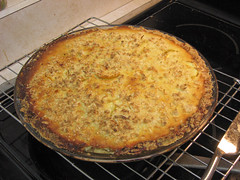
I have a recipe clipping from the 90’s for a yogurt pie prepared in an 8″ graham cracker crust. The pie had the ratios of 1/2 packet of gelatin to 1 c water to 1c yogurt to 8 oz of cream cheese, and i’d often made it with mixed berries. I made it several summers in Philadelphia but haven’t felt much motivation since moving to California until now.

I found a second recipe that looked interesting, and i used up the last of the gelatin making it. (I was intrigued by the pineapple-gelatin combination, but then read that the problem is with *fresh* pineapple.)

Since i’d wanted to replace the gelatin with a vegetable gelling agent, i gave tapioca a try in a berry variation. I used ratios more like the new recipe, which did not call for cream cheese. I’m not sure i prepared the MINUTE® tapioca appropriately: it said it could be microwaved on high for ten minutes, stirring every three minutes. I think this may have overcooked it. It seemed very gelled when done, but when mixed in with the yogurt i think it did not reset. I poured it over blueberries and laid out stripes of sliced strawberries across the top.

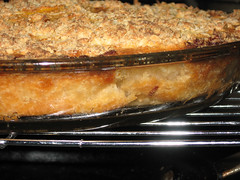
The first “pie” provided a good control case to compare to the tapioca-yogurt mix. It certainly gelled and could be cut with a knife, leaving solid bar shapes. The tapioca-yogurt mix retained some definition, but couldn’t be served retaining shape. Since i was leaving out crusts in both cases, if the texture doesn’t change much it begs the question of why not just flavor the yogurt and be done.

Both were yummy though!

Quick research this afternoon suggest that cornstarch may set up more firm, but needs a higher gelatinization temperature.

Mixing yogurt with something hot deserves two points of attention. one is that the active cultures die above 120° F, the other is that non-fat yogurt will curdle.

More about gelling agents, and pineapple & gelling agents, after the cut.
(more…)

Notes From Color By Accident & elsewhere

Friday, June 26th, 2009

My first post about dyeing fabric is here. I requested a couple books from the library via ILL that weekend, including Ann Johnson’s Color By Accident. Much of her text is about color mixing: it may be an interest i grow to have, but it’s not where i’ll start. I’ve selected preblended colors from Dharma. AJ’s text has some interesting instruction on the techniques of low water immersion dying, though, so i’ve taken notes on her technique (after the cut) and will annotate over time with other references.
(more…)

Golden Acrylics in the Bay Area (and beyond)

Monday, December 1st, 2008

I’ve been on Tesia Blackburn’s mailing list for some time, imagining signing up for her classes and lectures but never quite getting around to it (just like the harmonica classes). Today brought her winter newsletter to my mailbox. First, there’s a Golden lecture in January, free. I enjoyed the lecture i went to years ago at Flax, so i’ve emailed my interest. She’s also doing a webinar on monoprints with OPEN — after doing my experimentation this summer, i’m particularly interested.

She also had a good tip — reminder — about using glazes. The Golden website ranks the opacity of the pigments, a good clue in keeping translucency. In my palette, Naphthol Red Light (Op=4) and the Phthalo blue (gs) & green (bs) (Op=3) aren’t particularly translucent. I could get Quinacridone Red (Op=6) and Ultramarine Blue (Op=6), but there isn’t a more translucent fluid green.

Golden OPEN acrylics

Wednesday, October 1st, 2008

The latest Just Paint has some comparisons and samples of the new OPEN medium. I’m excited by the description of it being “greasy” with a long working time. It makes me think of how i’ve played with the tar gel to get a paint i can push around. There’s some small works i did with oil pastels ages ago, and i’d like to get that effect.

There’s two introductory sets. The colors i’m used to are the modern colors:

Introductory Set of 6, Modern Colors — This set contains .75 oz (22 ml) tubes of 6 modern colors, including one each of Hansa Yellow Opaque, Pyrrole Red, Quinacridone Magenta, Phthalo Blue (Green Shade), Phthalo Green (Blue Shade), and Titanium White.

I think my mixing sheets have a different red (Naphthol Red Light), and Hansa yellow is such an impotent pigment. For $16.76 at Dick Blick, this will be a good place to play and experiment. I’m not sure when i’ll invest: Christine has a big painting on the easel at the moment, and i’ve been utterly preoccupied by yarn.

UPDATE: At some point in the past couple of weeks, Golden sent a hard copy of their Just Paint and a sampler including Alizarin Crimson, Phthalo Blue (Green Shade), and Titanium White in 8 ounce sampler tubes. I look forward to playing with them! 2008-10-15